Multi-modal Modeling#
MESA Modeling#
CFTK includes MESA-style multimodal modeling commands.
Install the analysis dependencies, including mesa-cfdna, before using
these commands:
python -m pip install ".[analysis]"
Run modality performance screening:
cftk --config cftk_init.json mesa --performance
Run model construction:
cftk --config cftk_init.json mesa --mesa-model
Run leave-one-out cross-validation and plots:
cftk --config cftk_init.json mesa --loocv
Commonly used together:
cftk --config cftk_init.json mesa --performance --mesa-model --loocv
Expected Outputs#
MESA writes a compact set of tables, a serialized model, and LOOCV figures:
results/5_mesa/
|-- label.tsv
|-- modality_performance.tsv
|-- MESA_model.pkl
|-- loocv_predictions.tsv
|-- mesa_roc.png / mesa_roc.pdf
|-- mesa_heatmap.png / mesa_heatmap.pdf
`-- mesa_spearman.png / mesa_spearman.pdf
The observed visual below combines those plot families with the prediction
table for five controls and five sALS samples. It is a technical workflow
example only. In particular, perfect-looking internal screening values can
occur in a ten-sample run and do not estimate performance for a cohort or a
clinical assay. Inspect loocv_predictions.tsv, the model settings, and the
provenance manifest before interpreting any result.
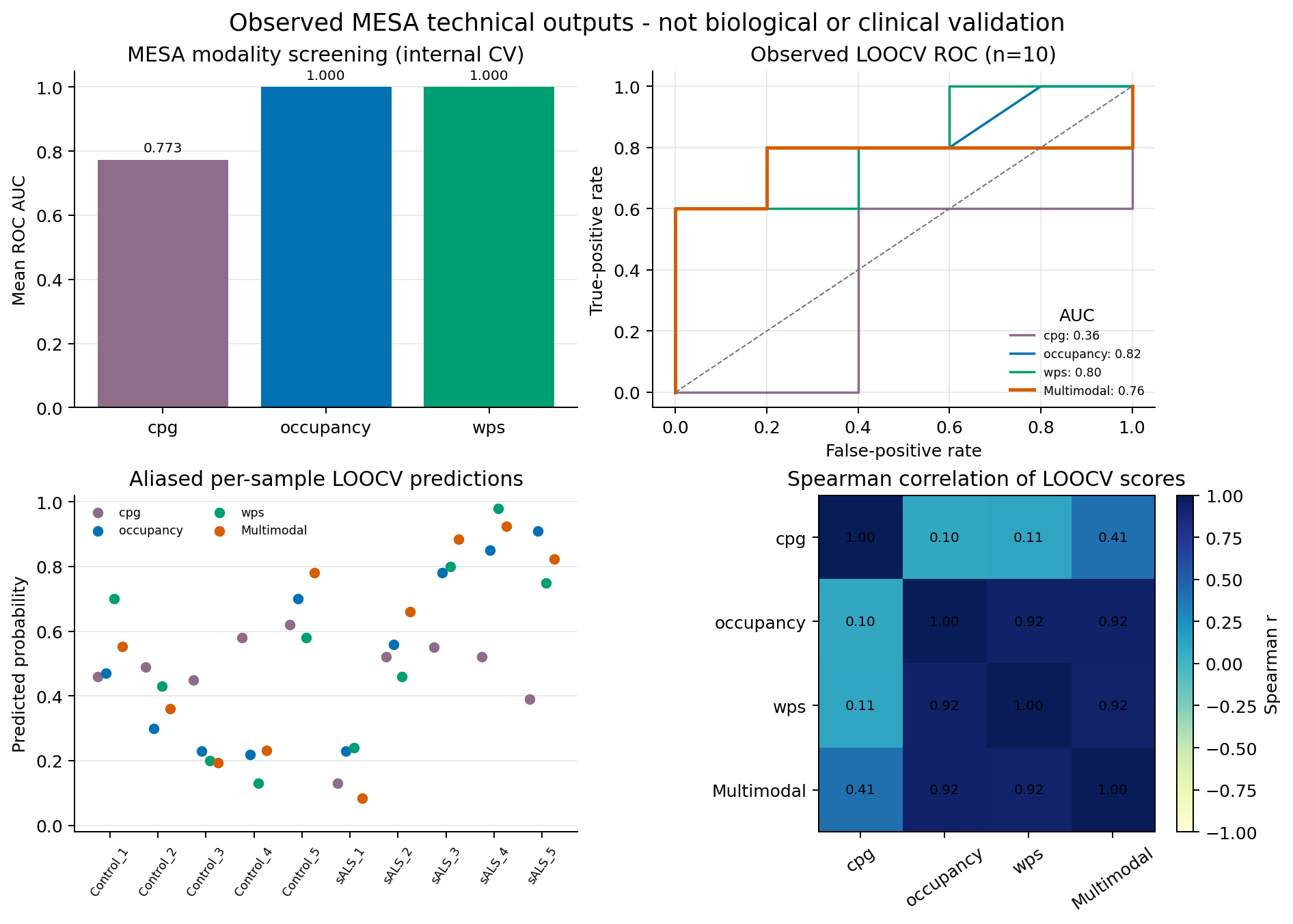
Observed MESA output from five controls and five sALS samples. The
internal screening bars and LOOCV curves are descriptive artifacts from this
ten-sample technical run, not biological or clinical validation and not a
recommended acceptance threshold. Download the sanitized aggregate
metadata:
JSON.#