Model-Development Power#
CFTK estimates the probability that a fixed biomarker-discovery pipeline reaches a target out-of-fold cross-validated AUC for a proposed total study sample size. Filtering, imputation, feature ranking, feature selection, scaling, and model fitting are repeated inside every training fold.
The power output is the fraction of simulated studies whose CV AUC reaches
target_auc. It evaluates internal model-development adequacy and does not
estimate external generalizability.
This workflow is not the cftk power command. That legacy CLI command
performs CpG-level analytical power calculations from a configured pickled
standard-deviation table. Model-development power is exposed through the
Python API and Streamlit calculator and uses the manifest-backed NumPy arrays.
For an interactive interface to this workflow, see Model-Development Power Calculator.
The main functions are:
analysis.model_power.load_default_model_power_referenceanalysis.model_power.prepare_template_ensembleanalysis.model_power_discovery.run_power_sample_size_gridanalysis.model_power_operating_characteristics.run_power_sample_size_gridvisualization.plot_model_power.plot_power_by_sample_size
The Python distribution contains these APIs but not the aggregate reference arrays. Load repository-hosted or separately obtained arrays explicitly:
from analysis.model_power import load_default_model_power_reference

reference = load_default_model_power_reference(
    reference_dir="/path/to/CFTK/data",
    depths=[10, 30],
    sd_stats=["mean"],
    include_index=False,
)
CFTK_MODEL_POWER_DATA can provide the same directory for installed callers.
The GitHub Streamlit application passes its repository-local data/ path.
End-To-End API Smoke Test#
The following small calculation verifies reference loading, template
preparation, cross-validation, and matched null calibration. Run it from a
repository checkout after python -m pip install ".[analysis]":
from analysis.model_power import (
    load_default_model_power_reference,
    prepare_template_ensemble,
)
from analysis.model_power_operating_characteristics import (
    run_power_sample_size_grid,
)

reference = load_default_model_power_reference(
    reference_dir="data",
    depths=[10],
    sd_stats=["mean"],
    include_index=False,
)

templates = prepare_template_ensemble(
    reference.cpg_std_summary,
    reference.cpg_mean,
    n_templates=1,
    template_kwargs={
        "depth": [10],
        "n_features": 20,
        "n_signal_cpgs": 4,
        "meth_diff": 0.06,
        "effect_sd": 0.01,
    },
    random_state=42,
)

result = run_power_sample_size_grid(
    templates,
    sample_sizes=[20],
    simulations_per_template=1,
    null_simulations_per_template=19,
    power_kwargs={
        "models": ("logreg",),
        "cv_folds": 2,
        "top_k": 3,
        "target_auc": 0.70,
    },
    alpha=0.05,
    ci_method="none",
    n_jobs=1,
    random_state=43,
)

columns = [
    "sample_size",
    "mean_depth",
    "mean_cv_auc",
    "detection_power",
    "target_attainment_probability",
    "probability_of_success",
]
print(result["power_curve"][columns])
The result also contains replicate_results, null_replicate_results,
template_summary, and run_metadata. This one-template, one-simulation
example is only a wiring smoke test. Increase template and simulation counts
for study-design analysis; use substantially more null simulations when precise
tail probabilities are required.
Use ci_method='none' for fast web calculations. Pooled Wilson and
hierarchical bootstrap intervals are available when uncertainty estimates are
required.
Expected Outputs#
The model-development API returns results in memory; it does not silently
create a results/ directory. The principal output contract is:
result["power_curve"]              one row per depth/template/sample size
result["replicate_results"]        signal-study diagnostics
result["null_replicate_results"]   matched null-calibration diagnostics
result["template_summary"]         sampled-template metadata
result["run_metadata"]              settings, seeds, and implementation IDs
Callers who need files can export the returned frames explicitly, for example
with result["power_curve"].to_csv("power_curve.tsv", sep="\t"). The
figure below is a fixed-seed synthetic rendering of the API’s curve and
replicate diagnostics; it is not a study-design recommendation or a real
cohort result.
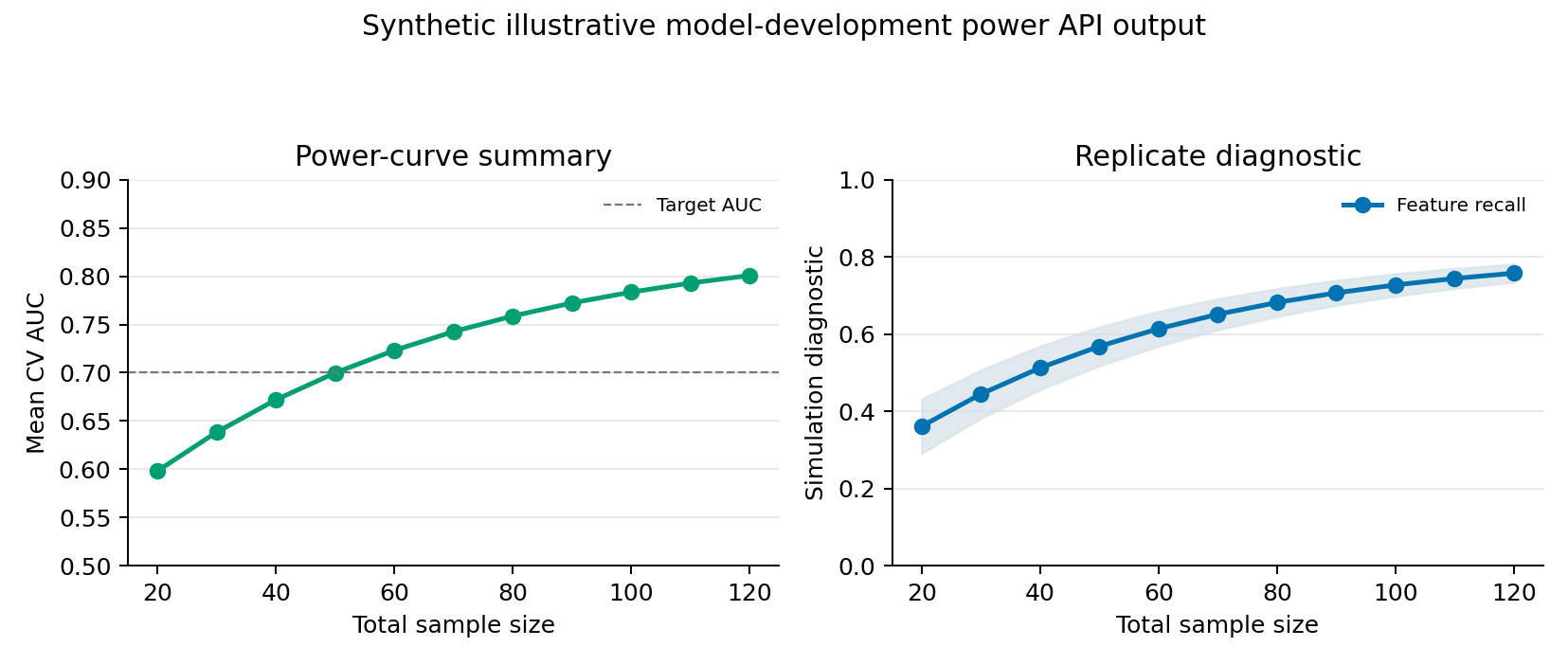
Synthetic illustrative API output. The actual values depend on the selected reference arrays, templates, seeds, and simulation counts.#