Internal Validation Record#
This maintainer-only record shows how CFTK was checked against a historical ALS BAM cohort and how the default Sambamba duplicate-marking implementation was compared with Picard. It is not part of the beginner workflow, does not run automatically, and does not define a user-facing equivalence gate.
Keep the BAMs, scheduler logs, JSON reports, and command ledgers in a private validation directory. Do not commit patient-level files or absolute local paths to the repository.
Step 1: Audit The Cohort#
Start with a sample sheet that identifies the biological group and points to the BAM already produced by an upstream workflow. CFTK does not infer whether an external BAM was aligned or duplicate-marked from its filename alone.
Run the read-only doctor audit for methylation readiness:
set +e
cftk doctor --step 4 --json > doctor.json
doctor_status=$?
set -e
printf 'doctor exit status: %s\n' "$doctor_status"
An exit status of 1 means at least one required readiness check failed; it
is not a successful analysis. The JSON report preserves the reason for every
sample. Doctor never downloads, reindexes, rewrites headers, or modifies BAMs.
Convert the report into tables and a cohort-level figure:
python scripts/validation/summarize_doctor_audit.py \
    doctor.json samples.tsv validation/audit
The command writes:
cohort_readiness_checks.tsv: one row per sample and readiness check;cohort_readiness.tsv: one compact row per sample for filtering and review;cohort_readiness_summary.json: counts, interpreter, platform, and source report paths; andcohort_readiness.png: the figure below, with separate Control and sALS bars and color-independent status hatching.
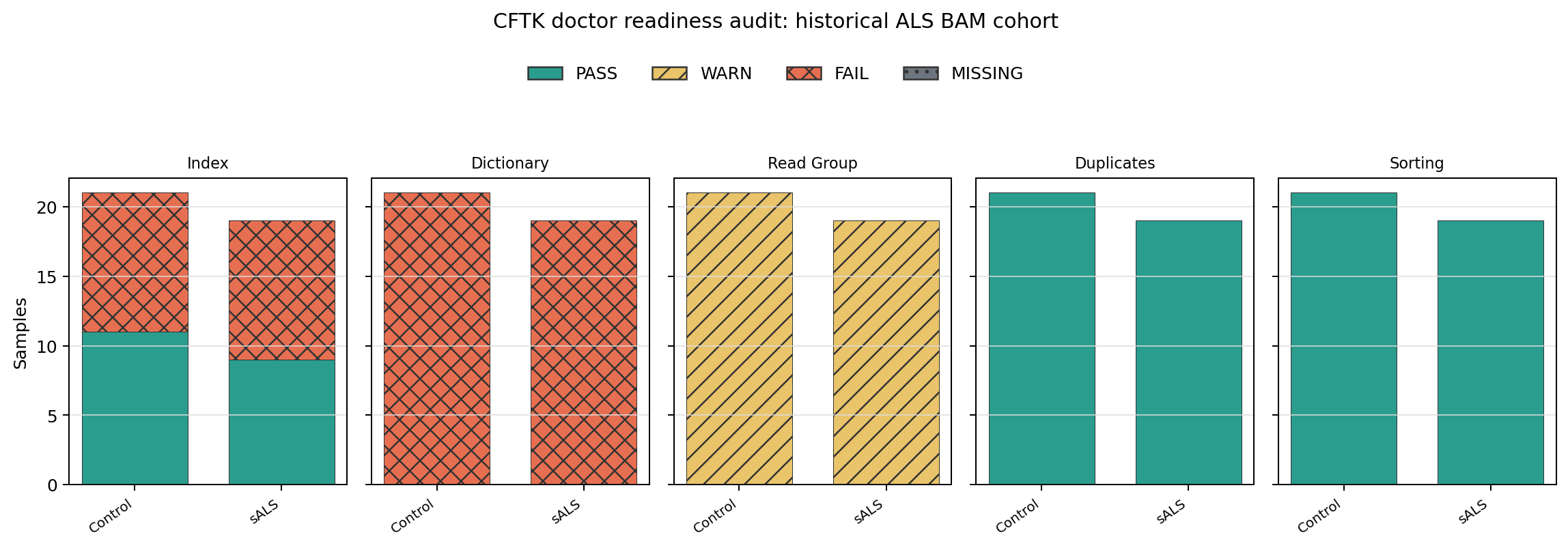
In the validation example, the cohort contains 21 controls and 19 sALS samples. All 40 historical BAMs fail the exact managed-reference dictionary check, 20 also have stale indexes, and all 40 have incomplete read-group metadata. Sorting and duplicate-marking provenance pass. The correct beginner action is to stop and resolve the reference/provenance issue, not to hide the failure by regenerating an index against a different reference.
Step 2: Choose A Technical Comparison Pair#
Duplicate-marking parity must start from the same pre-markdup alignment BAM. Comparing a Picard output against an already Sambamba-marked BAM is circular. The validation pair uses one control and one sALS sample from the preserved 5-million-pair Phase 13 run. Both alignment BAMs are coordinate-sorted and use the managed Twist/hg38 reference. The full-size historical pre-markdup BAMs were not available, so this is a technical subset comparison, not a cohort-wide biological acceptance result.
Record the selection and the M-bias-derived OT/OB bounds in a private manifest:
sample  group    input_bam  ot_bounds       ob_bounds
...     Control  ...        28,128,35,120   32,146,32,133
...     sALS     ...        29,138,28,119   33,124,34,132
The bounds are held constant between methods. That isolates duplicate marking
as the changed processing decision while retaining the production
--mergeContext --minDepth 10 --maxVariantFrac 0.25 extraction contract.
Step 3: Re-run Both Methods#
The validation runner recreates both methods from each common alignment BAM, then runs the same Twist covered-target Picard metrics and MethylDackel extraction on each output:
bash scripts/validation/run_duplicate_marking_comparison.sh \
    duplicate_manifest.tsv \
    /path/to/hg38_no_alt_analysis_set.fa \
    /path/to/twist_human_methylome_hg38_covered_targets.interval_list \
    validation/duplicate_compare 10
Every expanded shell command is recorded in commands.trace. Each tool
also has a /usr/bin/time -v resource report. The output directory contains
the two marked BAMs and indexes, Sambamba and Picard metrics, per-target
coverage, two MethylDackel CpG bedGraphs per sample, tool versions, and a
SHA-256 ledger. The runner refuses to overwrite an existing output directory.
Step 4: Compare Read And Assay Outputs#
The comparison helper reports raw measurements using the normal command settings for each tool. It does not accept a user-supplied tolerance or turn the comparison into a pass/fail decision:
python scripts/validation/compare_duplicate_marking.py \
    validation/duplicate_compare/comparison_manifest.tsv \
    validation/duplicate_compare/duplicate_marking_comparison.json \
    --metrics-dir validation/duplicate_compare/metrics \
    --methylation-dir validation/duplicate_compare/methylation
The JSON and TSV report, for each sample:
primary reads and reads flagged duplicate by each tool;
duplicate-read classification agreement and duplicate-key Jaccard overlap;
Twist target coverage differences from
CollectHsMetrics; andshared CpG loci, weighted methylation, and per-locus methylation differences.
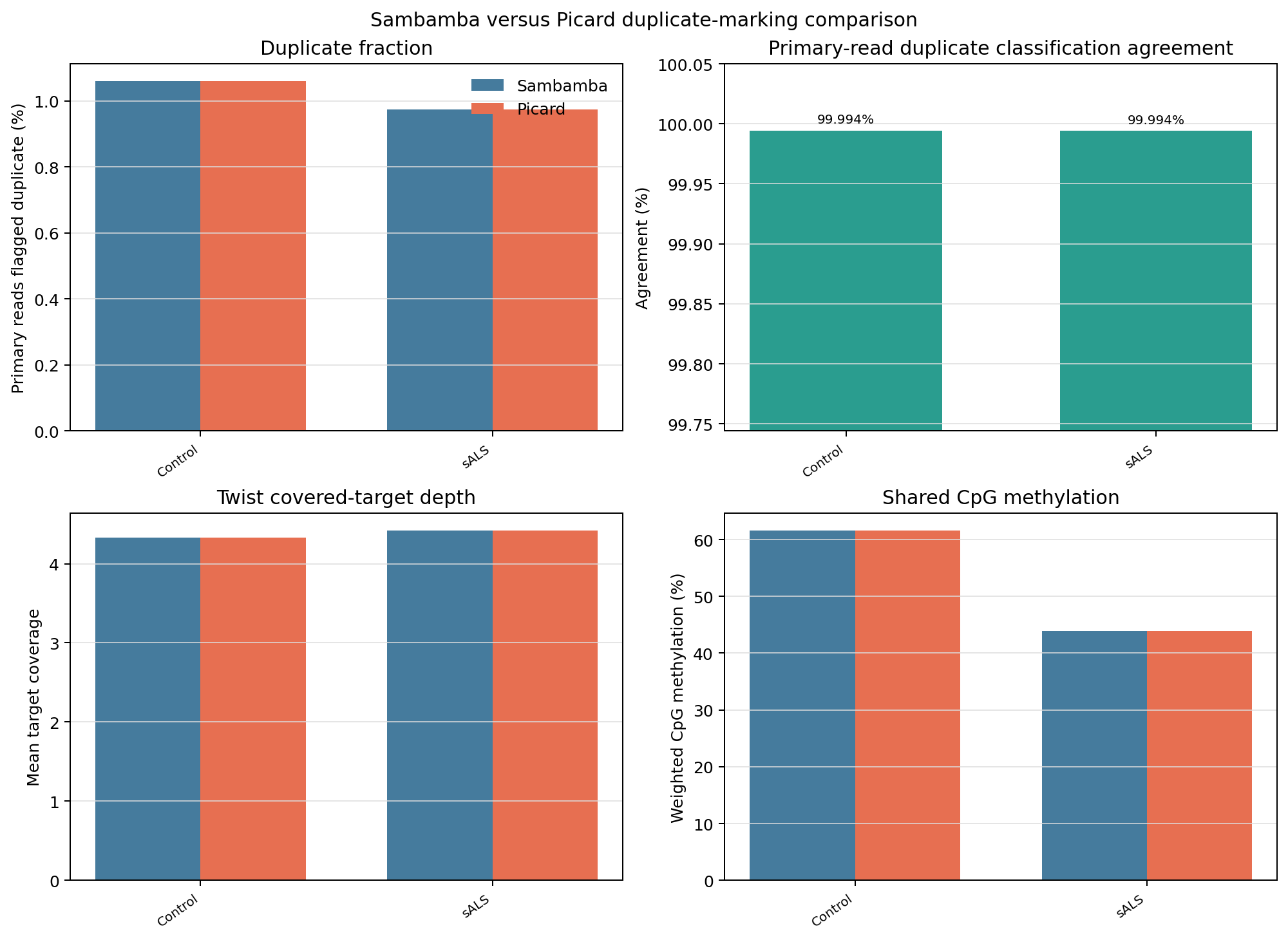
The figure is descriptive. This diagnostic is for maintainers and advanced users; it is not a user-facing gate, and ordinary CFTK runs never ask users to choose a cross-tool tolerance.
Measured Results From The Preserved Pair#
The first comparison completed successfully (Slurm job 55029223). Both
methods produced the same primary-read counts and duplicate fractions, but
they were not bit-for-bit identical: 540 read-mate keys differed in each
sample. The resulting agreement was 99.994% and the duplicate-key Jaccard
overlap was 0.994 or higher.
Group |
Primary reads |
Duplicate fraction (both) |
Read agreement |
Duplicate-key Jaccard |
Shared CpG / methylation delta |
|---|---|---|---|---|---|
Control |
9,376,875 |
1.0599% |
99.9942% |
0.994581 |
100% / 0.000107 percentage points |
sALS |
9,268,443 |
0.9741% |
99.9942% |
0.994037 |
100% / 0 percentage points |
Twist CollectHsMetrics reported identical mean target coverage and target
threshold fractions for both methods at the recorded precision: 4.326628 for
the control and 4.417667 for sALS. The output JSON and TSV preserve the full
precision, together with tool versions, per-command resource reports, and
checksums.
No acceptance tolerance is defined for this diagnostic. The recorded values are retained so maintainers can inspect the behavior of Sambamba and Picard under the normal tool settings; CFTK does not apply a cross-tool threshold and users do not need to make a threshold decision. The result is not a claim that the two tools are biologically interchangeable.
What This Does Not Prove#
Passing a two-sample technical comparison does not prove that the methods are interchangeable for every library, that the historical 40-sample cohort is ready, or that a biomarker is biologically valid. Keep the raw reports, figures, commands, tool versions, input hashes, and any accepted deviations together before calling the default workflow production-ready.
Expected Outputs#
The validation steps leave an auditable bundle rather than only a pass/fail sentence:
validation/audit/
|-- cohort_readiness_checks.tsv
|-- cohort_readiness.tsv
|-- cohort_readiness_summary.json
`-- cohort_readiness.png

validation/duplicate_compare/
|-- commands.trace
|-- comparison_manifest.tsv
|-- duplicate_marking_comparison.json
|-- duplicate_marking_comparison.tsv
`-- metrics/ and methylation/ reports
The figures and raw tables are descriptive records for the selected technical subset. They are not a user-facing acceptance gate, and they do not replace independent biological or clinical validation.
Step 5: Export Public Documentation Evidence#
The maintainer documentation panels are regenerated from the completed five-control/five-sALS result tables with deterministic public aliases. Run this command only from a private validation workspace; the input project root must not be committed:
python scripts/validation/export_downstream_documentation.py \
    --project-root /path/to/private/cftk_validation_run \
    --output-dir docs/_static
The exporter streams the large matrices, checks the exact 5+5 sample contract,
and writes four PNGs plus validation_10sample_downstream_summary.json. It
does not copy BAMs, source tables, the private report, sample identifiers, or
absolute paths. The generated figures are documentation evidence only; they
must retain the explicit technical-example and targeted-panel limitations used
on the public user-guide pages.
Step 6: Run The Lab Release Gate#
This final check is for CFTK maintainers, not ordinary package users. It proves that one core Twist workflow attempt executed every applicable stage, that the recorded commands and required artifacts are complete, and that immediately repeating the unchanged workflow reused those artifacts without executing a command. It does not add a biological, numerical, or cross-tool threshold.
Use a dedicated private validation project. The accepted clean attempt must
record complete for every applicable stage; adopted or resumed is
not a substitute for clean execution. Do not use --adopt-existing for that
attempt. Capture the immutable manifest path before running the same command a
second time:
export PRIVATE_VALIDATION=/path/to/private/cftk_release_validation

cftk --config "$PRIVATE_VALIDATION/cftk_init.json" run
clean_run=$(jq -r '.manifest' \
    "$PRIVATE_VALIDATION/results/provenance/latest-run.json")

# Do not edit the config, inputs, references, outputs, or run options.
cftk --config "$PRIVATE_VALIDATION/cftk_init.json" run
resume_run=$(jq -r '.manifest' \
    "$PRIVATE_VALIDATION/results/provenance/latest-run.json")

python scripts/validation/check_release_gate.py \
    --clean-run "$clean_run" \
    --resume-run "$resume_run" \
    --output-dir "$PRIVATE_VALIDATION/release-gate"
The command exits 0 only when both manifests are complete, project and
artifact identities agree, the second attempt points directly to the clean
attempt, all clean stages are complete, all resume stages are resumed,
every clean command has one zero-exit finish, the resume command ledger is
empty, doctor has no failures, and every required artifact still satisfies its
recorded nonempty contract. Artifact tables, event ledgers, tool-version
records, and schema-version evidence are checked as well.
The gate writes two deterministic records:
release-gate/
|-- release_acceptance.json
`-- release_acceptance.txt
These records contain run IDs, project-identity hashes, core stage IDs and statuses, contract hashes, and aggregate counts. They intentionally omit input paths, commands, sample-derived filenames, sample identifiers, and patient-level values. Keep them in the private validation workspace and review them before sharing; never commit the private project, scheduler logs, or raw gate inputs.
CFTK core run schemas 1 through 4 are supported. Schema 3 requires its
integrated evidence bundle. Schema 4 additionally requires a clean,
revision-bound software_identity in both manifests and the same identity in
each runtime.cftk doctor check. This prevents automatic reuse of artifacts
after the CFTK payload changes. Earlier complete manifests predate software
identity, so schemas 1–3 remain readable and are validated using their stable
run-level records and artifact contracts.
The software identity contains only the package version, Git revision/source, dirty state, and SHA-256 values. It contains no checkout path, sample name, command, or scheduler account. The downstream workflow records the same identity in its schema-v2 plan and manifest. A different identity causes the stage to execute again; a valid unchanged precursor is still discovered and reused automatically.
Scheduler use is optional and external to the gate. The same procedure is valid in a local process or an approved institutional allocation. If Slurm is used, submission and monitoring are advanced maintainer tasks: use the lab or institutional account, preserve the scheduler logs privately, and do not add account names or cluster-specific paths to this repository.
Preserved Two-Sample Result#
The preserved two-sample Twist technical pair passes this gate. The clean attempt completed all seven applicable stages with 24 paired zero-exit commands, 26 passing doctor checks, 11 passing tool probes, and all 72 required artifacts present (56 output/report rows and 16 figure rows). Its immediate successor resumed all seven stages with an empty command ledger and the same project, tool, stage, and artifact identities. This is execution and reproducibility evidence for a bounded technical example, not biological or clinical validation.